
1-900x600
2-900x600


Interactive Fountain “The Silk Road”
Subscribe to our YouTube channel to see more videos of our products!
Fountain with an Interactive Art Installation Created for Uzbekistan
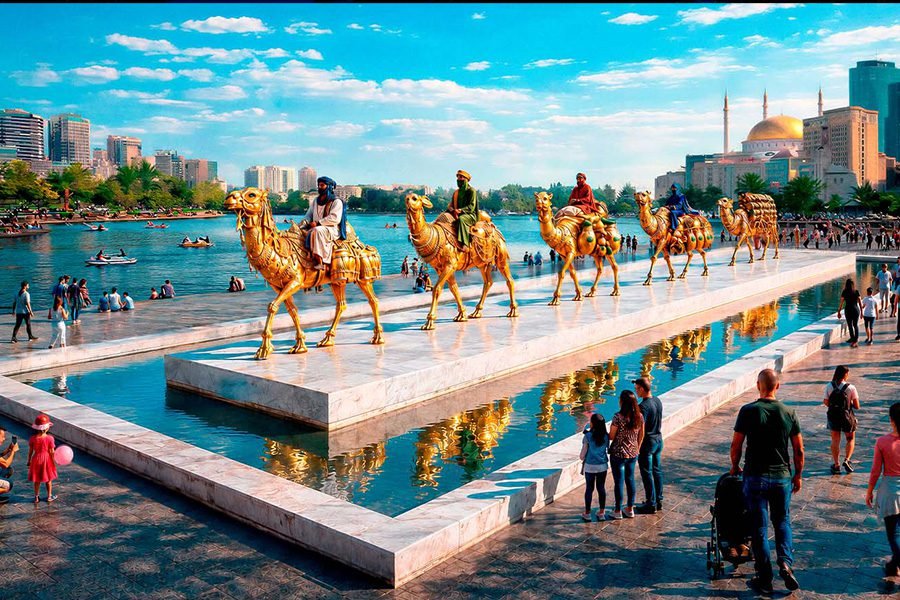
“The Silk Road” is a monumental fountain with an interactive art installation, specially developed as an artistic tribute to Uzbekistan — a country whose history is inseparably connected with the Great Silk Road.
For centuries, the territory of modern Uzbekistan was one of the most important centers of this legendary route. Caravans passed through these lands, cultures met, trade developed, and knowledge, crafts, architecture, music, and ideas spread across regions. Samarkand, Bukhara, Khiva, Tashkent, and other historic cities became not merely points along a trade route, but true cultural bridges between East and West.
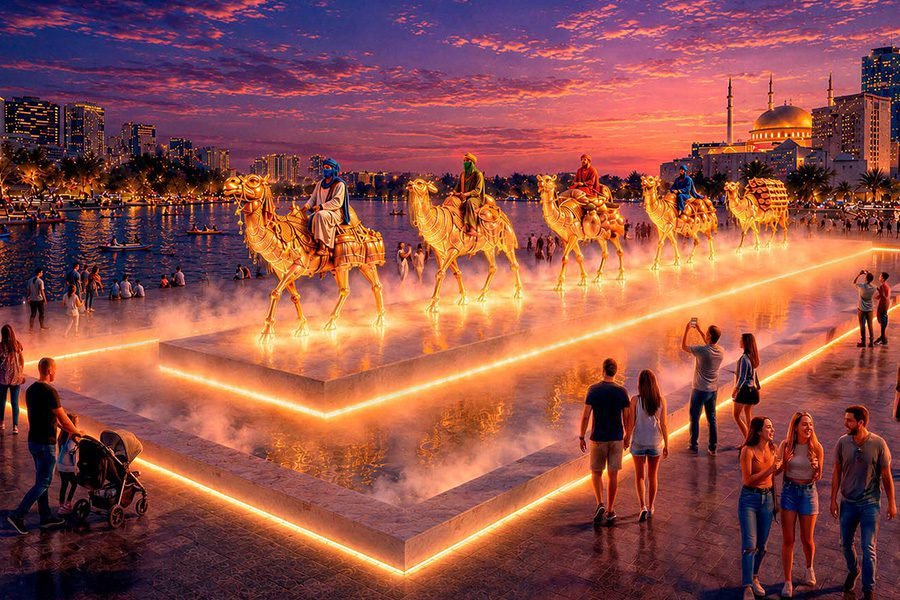
The “Silk Road” installation brings this heritage into a contemporary public space. At the center of the composition is a caravan of five bronze camels moving through water, light, mist, and reflections. This is not simply a decorative image, but a symbol of the route that, for centuries, connected peoples, cities, markets, palaces, workshops, mosques, caravanserais, and great civilizations.
The project combines sculpture, water, architectural lighting, sound, interactive technologies, and atmospheric mist. During the day, the object is perceived as a solemn sculptural composition with museum-like expressiveness. In the evening, it transforms into a striking illuminated environment, creating a powerful visual image and a prestigious point of attraction.
Uzbekistan — The Heart of the Great Silk Road
Uzbekistan holds a special place in the history of the Silk Road. It was here that caravan routes intersected with great cities where trade, science, crafts, diplomacy, architecture, and art flourished.
Samarkand was one of the brightest centers of attraction for merchants, scholars, and travelers.
Bukhara became a symbol of spiritual culture, knowledge, and Eastern trade.
Khiva preserved the image of an ancient museum-city, where history can be felt in its architecture and urban space.
Tashkent was an important point where trade and cultural flows intersected.
Not only goods passed through these lands. Ideas, technologies, languages, artistic styles, and worldviews also traveled here. That is why Uzbekistan can be seen not simply as part of the Silk Road, but as one of its main historical pillars.
The “Silk Road” installation emphasizes this role and transforms it into a contemporary artistic symbol.
The Caravan as an Image of Historical Memory
The main visual element of the installation is five bronze camel sculptures.
The caravan moves along an elongated marble platform surrounded by water. This solution creates a sense of a solemn route, direction, and forward movement.
Here, the camels are not decorative figures, but symbols of endurance, dignity, trade, travel, and great cultural exchange. They recall the caravans that passed through the lands of Uzbekistan for centuries, connecting China, India, Persia, the Arab world, the Mediterranean, and Europe.
The water surrounding the platform enhances the sense of space and depth. It reflects the bronze sculptures, architectural lighting, and the surrounding environment, making the composition look monumental, noble, and premium.
Light, Sound, and Mist as the Atmosphere of an Ancient Route
The installation functions not only as a sculptural fountain, but also as a full audiovisual object.
A system of 110 RGB luminaires makes it possible to create refined lighting scenarios: the warm golden glow of bronze, evening architectural accents, dynamic waves of light, and illumination of the water, marble platform, and sculptural group.
The mist generation system adds depth and theatricality to the composition. A light mist around the caravan creates the atmosphere of a mirage, an ancient route, a desert horizon, and a space dissolving into light.
20 concealed acoustic systems can complement the object with sound scenarios: the sound of wind, distant caravan sounds, Eastern musical motifs, soft atmospheric effects, or specially created compositions for evening shows.
Light, sound, water, and mist form a complete emotional experience. Visitors do not simply see a fountain — they feel the atmosphere of a journey where Uzbekistan’s past connects with its contemporary image.
Interactive Experience
The installation includes 20 interactive modules that allow visitors to become part of the experience.
When visitors interact with the modules, lighting and sound scenarios can be activated: accent lighting on individual sculptures, movement of light along the caravan route, sound effects of the journey, mist scenes, or thematic episodes connected with different stages of the Silk Road.
This mechanic transforms the fountain from a static composition into a living interactive space. The visitor does not simply observe the object — they activate the story, launch the atmosphere, and become a participant in a great journey.
A Cultural Symbol of Modern Uzbekistan
“The Silk Road” can become not only an element of public-space design, but also a new cultural symbol of the territory.
For Uzbekistan, this installation is especially organic: it speaks the language of the country’s history, emphasizes its role in world civilization, and shows how a great heritage can be reinterpreted through contemporary art, light, water, and interactive technologies.
The object works simultaneously as:
a fountain;
a sculptural composition;
a light installation;
an interactive object;
a tourist attraction;
a photo zone;
a cultural landmark of the place.
It can become a point where residents and guests of the country feel the scale of Uzbekistan’s historical heritage — not through a museum display case, but through a living urban space.
An Urban Point of Attraction
During the day, the object attracts attention through its scale, noble materials, expressive bronze sculptures, marble platform, and mirror-like water surface.
In the evening, the installation reveals itself through architectural lighting, reflections, mist, and sound scenarios, transforming into an atmospheric dominant feature of the space.
Such a fountain can become the central element of a city square, waterfront, park, tourist area, or contemporary public space — an object around which walking routes, photo content, tourist interest, and vibrant urban activity naturally form.
Where the Installation Can Be Used
“The Silk Road” is especially well suited for Uzbekistan and other countries where it is important to create an object with a strong historical foundation, a premium visual image, and cultural significance.
The installation can be placed:
in city squares and parks;
on waterfronts;
near museums and cultural centers;
in historic districts of the city;
near hotels and resort complexes;
in tourist areas;
in exhibition and event spaces.
For a city, the object can become a symbol of historical depth, cultural connection, and openness to the world.
For a tourist area, it can become a vivid attraction and prestigious photo location.
For a hotel or resort, it can become a premium evening object and an expressive element of the territory.
For a public square, it can become a place for meetings, walks, and visitor attraction.
Technical Specifications
Dimensions:
height — 3 m
length — 26 m
width — 10 m
Materials:
bronze, marble
Number of sculptures:
5 camels
Number of RGB luminaires:
110 pcs.
Number of interactive modules:
20 pcs.
Number of concealed acoustic systems:
20 pcs.
Power consumption:
approximately 25 kW
“The Silk Road” — A Fountain That Connects Past and Future
“The Silk Road” is not just a decorative fountain. It is a cultural installation created as a contemporary artistic interpretation of Uzbekistan’s great historical heritage.
The object brings together art, history, water, light, sound, and interactive technologies. It creates the atmosphere of a journey, emphasizes Uzbekistan’s role as one of the key centers of the Great Silk Road, and transforms public space into a place where history becomes a living experience.
Such an installation can become a new symbol of the territory — an image of movement, cultural connection, historical dignity, and a future built upon the strong heritage of the past.
Posted on GoogleTrustindex verifies that the original source of the review is Google. A very stylish and modern installation that fits perfectly into the urban environment.Posted on GoogleTrustindex verifies that the original source of the review is Google. Incredibly beautiful artPosted on GoogleTrustindex verifies that the original source of the review is Google. The light installations are unreal. Recently went to Soul Space Cleveland and NüIQ Wellness and they look insane. They add such a cool vibe to the spaces and made the experience way better. Did a sound bath at Soul Space and the lights made the event way more enjoyable and relaxing.Posted on GoogleTrustindex verifies that the original source of the review is Google. Dion art is like nothing I’ve ever seen before. It truly is mesmerizing. The art work exhibits true creativity and innovation.Posted on GoogleTrustindex verifies that the original source of the review is Google. I am fortunate enough to experience the beauty of NuIQ Wellness Lounge and Soul Space on a daily basis. The choreography of light and movement transforms static spaces into immersive environments. It’s not just something to see; they are something to feel, and to remember.Posted on GoogleTrustindex verifies that the original source of the review is Google. Pictures don’t do this beautiful art installation justice. Here at Soul Space we host multifaceted workshops and wellness classes, the addition of Dion art fixtures completely brings the space to life and is perfect for the space and what we do here. The capabilities of the installation is a whole immersive experience in itself. So beautiful!Posted on GoogleTrustindex verifies that the original source of the review is Google. Amazing things come from Dion Art! The light installations are so unique and elevated!Posted on GoogleTrustindex verifies that the original source of the review is Google. I’m a Nurse Practitioner at NuIQ Wellness Lounge in Cleveland, Ohio. I watched the vision come to life and how Dion Art completely transformed our space with their kinetic chandeliers and a bold parametric ceiling installation. To say it is completely breathtaking is an understatement. They also placed the most beautiful agate piece in the spa that I have ever seen- complete with a calming light show within it. Not only is the company so professional and meticulous about every detail, they are also very passionate about their work. Nothing but the best! To watch each of my patients come through our doors mesmerized is absolutely gratifying. I highly recommend Dion Art to anyone seeking to elevate their space with distinctive and artistic installations!Posted on GoogleTrustindex verifies that the original source of the review is Google. Kinetic Art Installation & Parametric ceiling! This installation is a stunning blend of artistry and engineering that brings movement and light to life in such a unique way. Watching the fluid, precise motions of each component is almost hypnotic, and it feels like you’re witnessing art that’s alive. The level of detail and craftsmanship is incredible, and the lighting adds such depth, creating shadows that shift and change as you watch. Dion Art has truly crafted something special here. It’s thought-provoking, calming, and captivating all at once. If you enjoy art that pushes boundaries and engages all your senses, this is a must-see!Posted on GoogleTrustindex verifies that the original source of the review is Google. The Cleveland Crystal, a stunning public art installation located on the West Mall in downtown Cleveland, is a mesmerizing work of art. Designed by the acclaimed firm Designers Dion, the Cleveland Crystal features captivating color-changing effects that enchant visitors. The firm is renowned for creating impactful art installations across the country, and the Cleveland Crystal is one of their most impressive creations.